
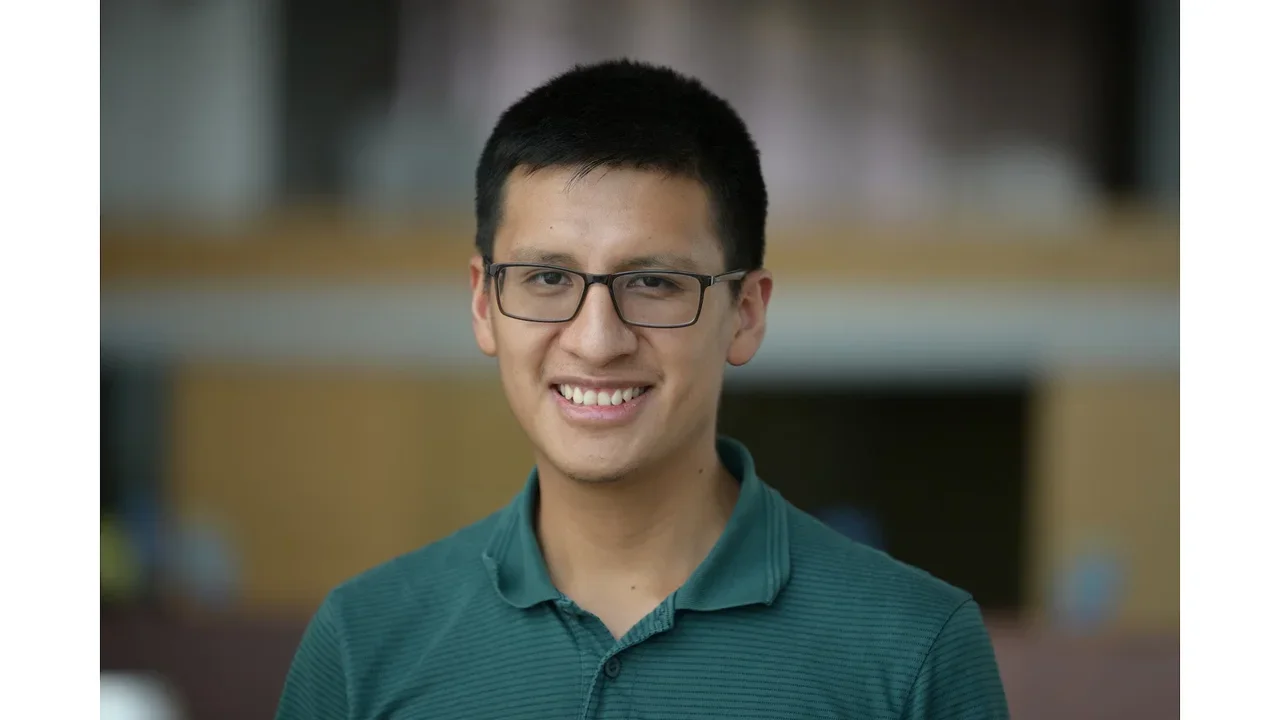
Fernando Zhapa-Camacho earns PhD on neuro-symbolic ontology embeddings
Fernando Zhapa-Camacho has completed his PhD in Computer Science with a thesis on neuro-symbolic methods that embed ontologies into latent spaces and apply them to protein function and gene-disease prediction.
About
Fernando Zhapa-Camacho has successfully defended his PhD thesis, Neuro-symbolic methods for embedding ontologies, and applications in life sciences, at KAUST, under the supervision of Professor Robert Hoehndorf. The work bridges symbolic ontology-based knowledge representation with neural, data-driven learning systems.
The first part of the thesis tackles a fundamental limitation of existing graph-based ontology embedding methods: they lack totality and injectivity, two properties needed to faithfully map information from an ontology into its latent space and back. Drawing on category-theoretic semantics of description logics, Fernando developed embedding methods that preserve the lattice structure of ontologies in the latent space. He extended the idea to knowledge graph embeddings with a fully geometric model, redesigning box embeddings so that logical operators such as intersection and negation are constructed geometrically rather than learned from data, improving interpretability and generalisation under complex queries.
The second part applies these embeddings to two biomedical problems. For protein function prediction, Fernando reformulates the task as positive-unlabeled classification rather than the standard closed-world multi-label setup, using information content of Gene Ontology classes as prior probability, a formulation that better reflects the open-world nature of functional annotation. For gene-disease association prediction, he introduces a new semantic similarity measure computed in the latent space, enabling inductive predictions that generalise to novel diseases while still exploiting expressive background knowledge.
Together, the thesis expands the semantics that latent representations of ontologies can preserve, advances neuro-symbolic reasoning, and shows that ontology-aware learning systems continue to be crucial for biomedical modelling. Congratulations, Dr. Zhapa-Camacho!