
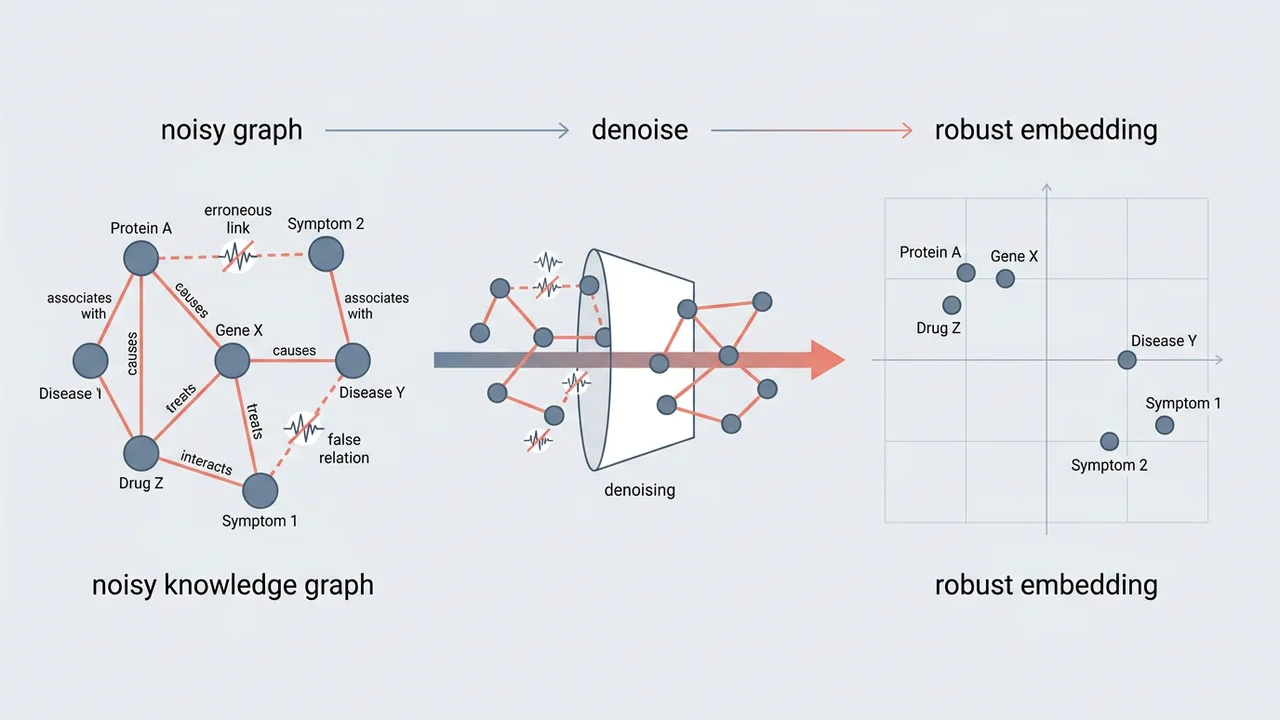
New publication at ESWC 2026: Robust knowledge graph embedding via denoising
A paper at ESWC 2026 by Tengwei Song, Xudong Ma, Yang Liu, Jie Luo and Robert Hoehndorf introduces a unified framework that hardens knowledge graph embeddings against perturbations in the embedding space, with certified robustness guarantees.
About
The Bio-Ontology Research Group, with collaborators at Beihang University, presented "Robust Knowledge Graph Embedding via Denoising" at the 23rd Extended Semantic Web Conference (ESWC 2026). The paper, by Tengwei Song, Xudong Ma, Yang Liu, Jie Luo and Robert Hoehndorf, addresses a vulnerability that has received much less attention than data-level noise: perturbations applied directly to the learned embedding space at deployment time, from quantisation, differential privacy noise, continual updates, or adversarial manipulation.
The framework adds denoising as an auxiliary learning signal and views knowledge graph embedding models as energy-based systems, exploiting the theoretical link between denoising objectives and score matching. The result is a model that learns stable gradients with respect to perturbed representations and is therefore more resilient to embedding-level noise. The authors also introduce certified robustness metrics based on randomised smoothing, giving a principled way to measure the radius within which model predictions are guaranteed not to change.
Across benchmark datasets, the framework consistently improves both predictive performance and robustness over a range of knowledge-graph-embedding model families, with particularly meaningful gains under substantial perturbations and in multi-hop reasoning scenarios: the regime where small distortions tend to compound across reasoning steps.
The paper is published in the ESWC 2026 proceedings; DOI: 10.1007/978-3-032-25156-5_22. Code is available at github.com/tewiSong/RKGE.