
Vanesa Gamez Baez earns MSc on multi-omics fidelity of colorectal cancer organoids
Vanesa Gamez Baez has completed her MSc with a thesis that uses a genome, transcriptome and proteome framework to test how faithfully patient-derived organoids from Saudi colorectal cancer patients recall the original tumors.
About
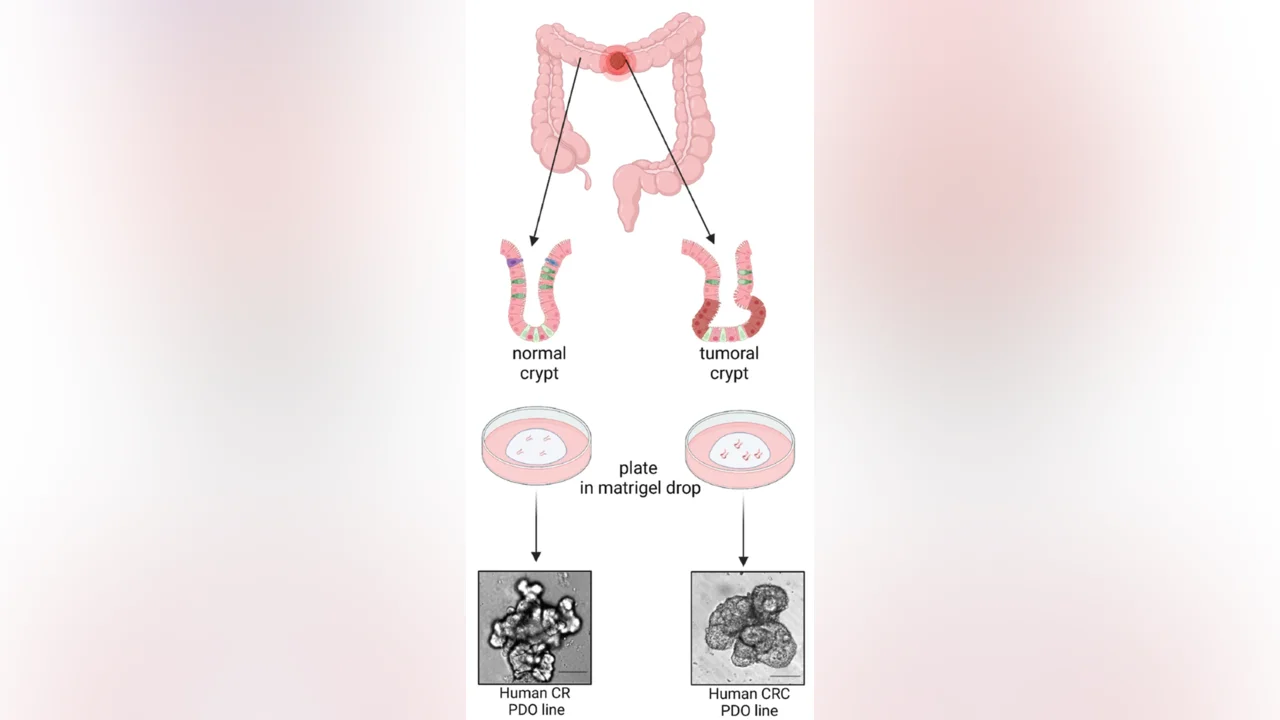
Vanesa Gamez Baez has successfully defended her MSc thesis, A Multi-omics Framework: Colorectal Cancer Patient-Derived Organoids as in vitro Oncology Models, at KAUST, under the supervision of Robert Hoehndorf. The work asks a question that is central to precision oncology: when a patient's tumor is grown in the lab as a three-dimensional organoid, how faithfully does that organoid still represent the patient's own cancer?
Patient-derived organoids (PDOs) are miniature, self-organizing cultures grown from a patient's own epithelial cells, and they are increasingly proposed as preclinical models for choosing treatments. Their usefulness rests on an unproven assumption: that they preserve the biology of the original tumor. Vanesa's thesis tests that assumption directly for a cohort of ten colorectal cancer patients from Saudi Arabia, a population in which the disease presents at a younger age and later stage than in Western cohorts, and for which representative models are scarce.
For each patient she profiled matched samples of tumor tissue, adjacent normal colon tissue, cancer organoids and normal organoids across all three molecular layers of the central dogma: DNA by whole-exome sequencing, RNA by RNA-seq, and protein by mass-spectrometry proteomics. Sequencing the DNA reveals which mutations are present, the RNA reveals which of those mutations are transcriptionally active, and the proteome reveals which are ultimately translated into functional proteins. The framework evaluates organoids along three axes: identity, fidelity and function.
The results show that germline variant concordance confirms organoid identity across the cohort, and that somatic fidelity tracks tumor purity: where the bulk tissue retains enough tumor cellularity for a fair comparison, cancer organoids recall the tumor's mutational program. At the transcriptomic level, organoids retain a coherent cancer-cell-intrinsic subtype identity, with the CRIS classification proving better suited to organoids than the more commonly used CMS scheme, because CRIS captures tumor-cell-intrinsic signals rather than the stromal and immune contributions that organoids lack. A key cautionary finding is that agreement at the genomic and transcriptomic level does not guarantee agreement at the protein level, which underscores why a multi-omics view is needed rather than any single assay.
Together the thesis provides a quantitative, multi-layer framework for judging when a colorectal cancer organoid can stand in for a patient's tumor, and shows that patient-derived organoids can recall the epithelial genomic and transcriptomic programs of the original tumor while flagging the limits of that fidelity. Congratulations, Vanesa!
Related People
Related Researchers

Dana Alhattab
- Research Scientist, Bio-Ontology Research Group