
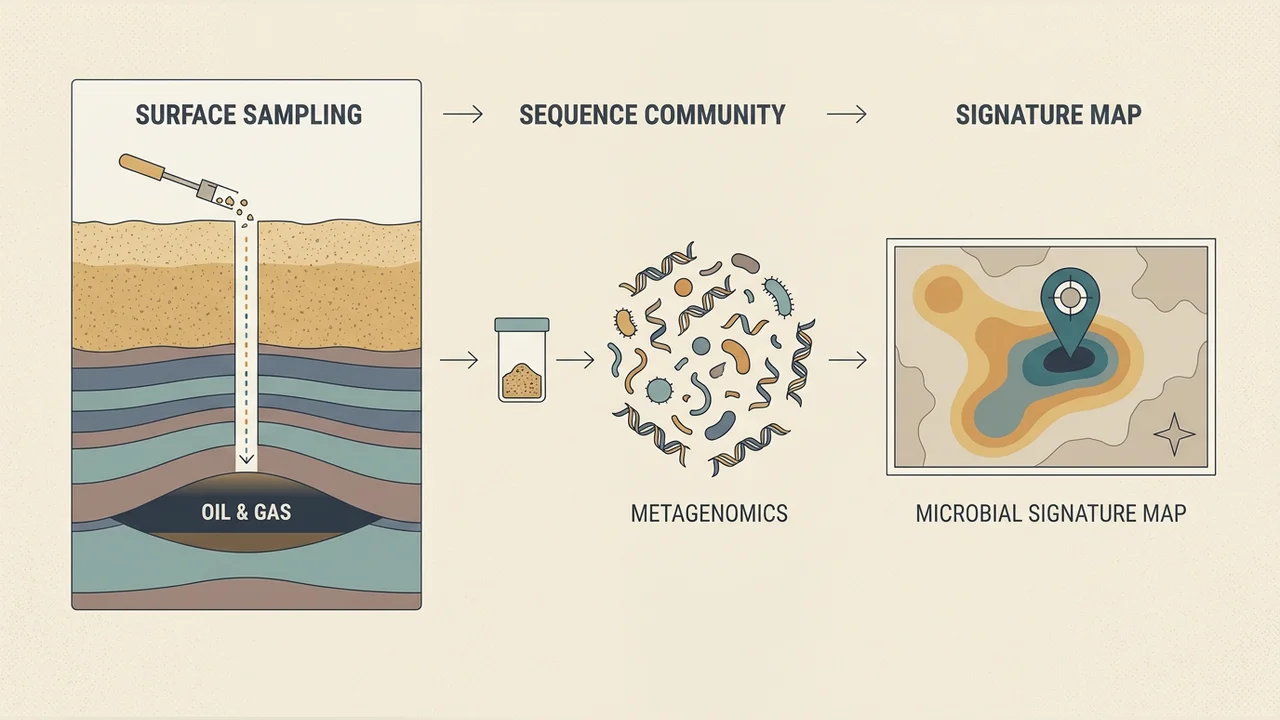
Metagenomics-based surface prospecting
Overview
Hydrocarbon-bearing geological formations carry a characteristic microbial signature. Methanotrophs that oxidize seep methane, methanogens that produce it, and sulfate-reducing bacteria that thrive at the oxic-anoxic boundaries created by hydrocarbon migration leave a detectable imprint in surface and near-surface soils. If that imprint can be read reliably, it offers an independent, low-cost screening modality to complement seismic surveys in exploration. The project, carried out for Saudi Aramco's Upstream Research Center under a 24-month scope of work (PI Hoehndorf, co-PIs Takashi Gojobori and Alexandre Rosado at KAUST, with Ameerah Bokhari at Aramco), set out to develop and validate such a screening platform.
The completed work, summarized in the final report Metagenomic Analysis of Soil Samples from Aramco Sites Using 16S rRNA Sequencing: Validated Technology with Patent-Ready Innovations, analyzed 300 soil samples collected at multiple depths across three Aramco drilling sites using 244 bacterial and archaeal 16S rRNA libraries, 31 whole-metagenome shotgun libraries, and XRF elemental analysis. Functional annotation of metagenome-assembled genomes was carried out with InterProScan and with DeepGOMeta, the BORG group's deep-learning method for predicting Gene Ontology functions in microbial communities, which made it possible to score proteins lacking characterized homologs.
The team built a multi-parameter scoring system that integrates four complementary signals: taxonomic biomarkers from 16S analysis, InterPro functional-domain signatures, AI-predicted GO functions from DeepGOMeta, and statistical enrichment patterns of protein functions. The framework recovered the expected biomarker organisms (Methylomonas, Methylomicrobium, Methanobrevibacter) and their enzymatic machinery (methyl-coenzyme M reductase, methane monooxygenase complexes), and showed 65-70% enrichment of hydrocarbon-associated taxa in positive sites versus 35-40% in the negative site, with sulfate-reducing bacteria 3.2-fold more abundant in positive sites.
The scoring system was validated against blinded drilling outcomes communicated by Aramco in mid-2025: Site 1 (drilling negative) received an integrated score of 0.211, while Sites 2 and 3 (drilling positive) received 0.796 and 0.801 respectively, and a between-site correlation analysis on the deep-soil microbiome (ρ = 0.98 between the two positive sites versus 0.86-0.90 with the negative site) provided an orthogonal discriminator that agreed with the scoring outcome. Four invention disclosures were submitted to Aramco in August 2025 covering the scoring algorithm, the curated functional biomarker database, the deep-learning biomarker discovery method, and the regional microbial signature database. The technology moved from proof-of-concept (TRL 2-3) to validated prototype (TRL 4), with a 2-4 additional sites validation campaign identified as the path to TRL 5.
Period: 2022–2024
Funding
- Saudi Aramco (industry contract)
— Grant ID:
RGC/3/4267-01-01(PI)
Team
- Robert Hoehndorf — PI (KAUST (Professor of Computer Science))
- Takashi Gojobori — CoI (KAUST (formerly CBRC, now dissolved))
Topics: Microbial communities