
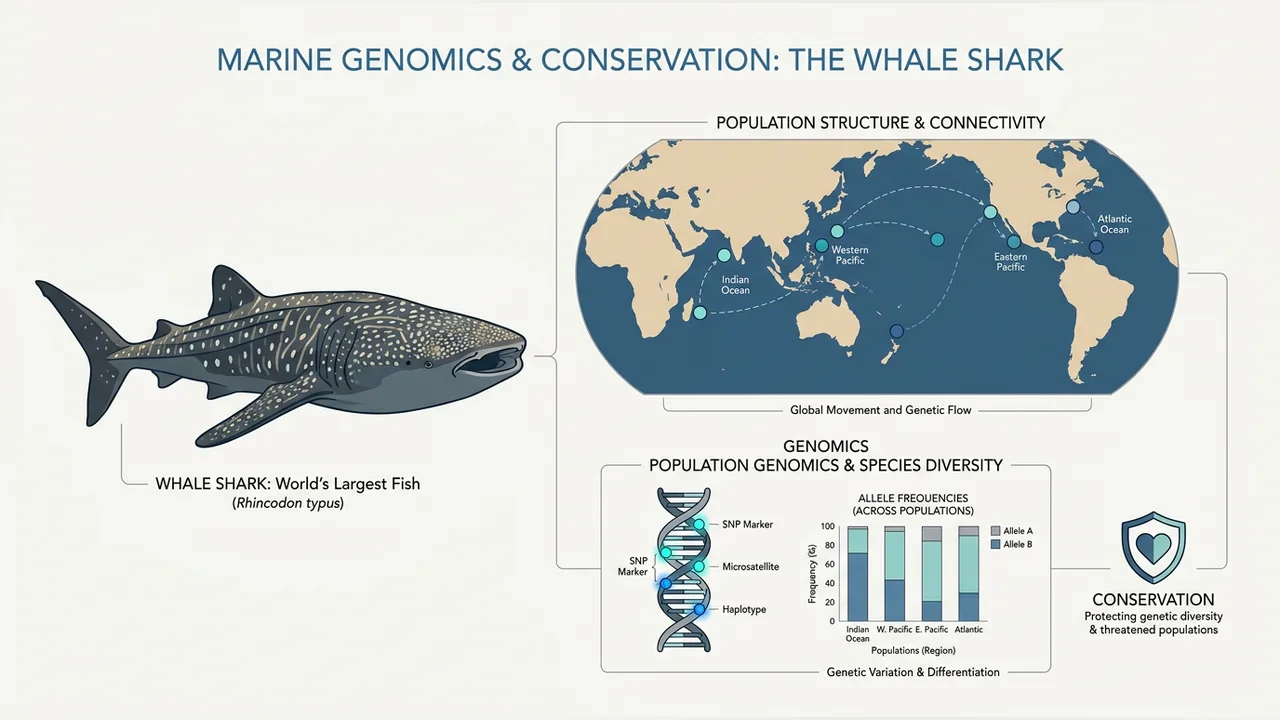
The Whale Shark 100: Applying Population Genomics to Understand Mysteries of the World's Largest Fish
Overview
This 2018–2020 KAUST Competitive Research Grant, led by Takashi Gojobori with Michael Berumen (KAUST Red Sea Research Center) and Robert Hoehndorf as co-investigators, used population genomics to address basic questions about Rhincodon typus, the largest extant fish. Whale sharks are globally distributed, highly mobile, and listed as endangered, and the Red Sea hosts a regular aggregation off the Saudi coast that is accessible to the KAUST marine science program. Despite their charisma, fundamental aspects of their population structure, connectivity between aggregations, and effective population size were poorly characterized, in large part because obtaining genome-scale data from a free-swimming, slow-reproducing, ocean-roaming animal is genuinely difficult.
The project assembled tissue samples from individuals across multiple aggregations and applied whole-genome and reduced-representation sequencing, with the aim of comparing Red Sea animals to other populations and characterizing genome-wide diversity and signatures of selection. The group's role was as a computational collaborator on the genomics analysis pipeline rather than as the marine-biology lead; this was a cross-institutional collaboration of interest, contributing ontology- and phenotype-aware variant analysis to a marine-genomics question. No publications are recorded against this grant in the group's bibliography, with the marine-science outputs sitting in collaborator publication lists.
Period: 2018–2020
Funding
- KAUST Competitive Research Grant
— Grant ID:
URF/1/3451-01-01(CoI) — USD 105,838
Team
- Takashi Gojobori — PI (KAUST (formerly CBRC, now dissolved))
- Michael Berumen — CoI (KAUST (Marine Science))
- Robert Hoehndorf — CoI (KAUST (Professor of Computer Science))
Topics: Genomics