Personalized cancer treatment prediction (KCSH Pathway to Impact 2025)
Overview
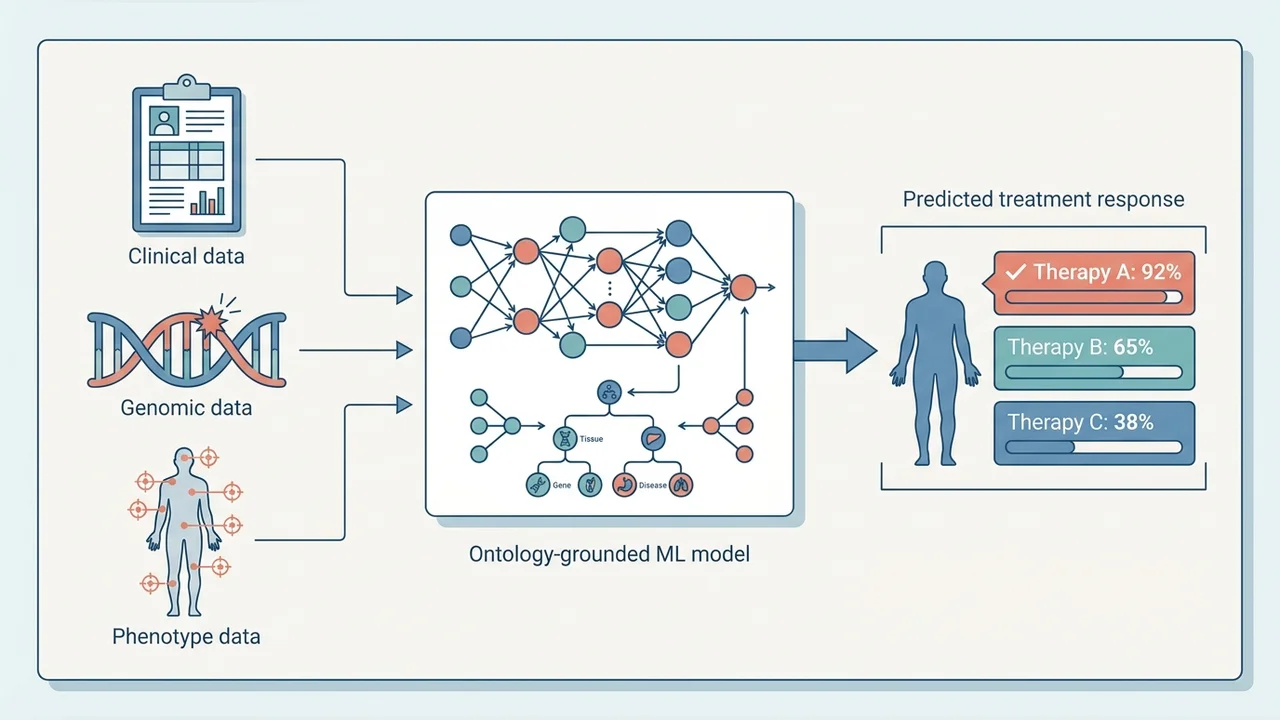
Predicting which drug will work for which patient is one of the oldest unsolved problems in oncology, and it is especially acute in Saudi Arabia, where colorectal cancer is the most common cancer in men and is shifting toward younger ages, and hepatocellular carcinoma incidence has roughly doubled in two decades. Contemporary machine learning models for drug response largely ignore the decades of curated biological knowledge that surrounds them, and they are almost never trained on Saudi populations. This project, funded under the KCSH Pathway to Impact 2025 call and running 2025-2026, aims to change that by building a neuro-symbolic prediction model that fuses multi-omics data with formal biological knowledge, and validating its predictions in patient-derived organoids grown from Saudi tumours.
The knowledge base is assembled in OWL by integrating DrugBank and ChEMBL drug-target data, STRING and BioGRID protein interactions, SIDER side-effect profiles, and DisGeNET and OMIM gene-disease links, with semantic structure provided by the Disease Ontology, the Human Phenotype Ontology, ChEBI, and the Gene Ontology. A dual-component model is then trained: a knowledge-based component learns drug embeddings from ontology axioms, while a projection network maps gene-expression profiles from the Cancer Dependency Map into the same vector space, so that comparing a patient's expression profile to a drug embedding is a meaningful prediction operation. The approach builds directly on the group's earlier work on approximate semantic entailment in Protein function prediction as approximate semantic entailment (Nature Machine Intelligence, 2024) and on zero-shot ontology-driven prediction in DeepGOZero: improving protein function prediction from sequence and zero-shot learning based on ontology axioms (Bioinformatics, 2022), which establish the principle that predictions can be made for drugs or proteins for which no training data exists, by reasoning over their position in the knowledge graph.
The clinical arm of the project is built around an established collaboration with the Department of Gastroenterological Oncology and Surgery at King Faisal Specialist Hospital and Research Centre (KFSH/RC) Riyadh, which is already producing preliminary colorectal cancer organoid data, captured in Sa1216: Development of colorectal cancer and matched healthy organoids from Saudi patients: a case study (Gastroenterology, 2025), and on chemically defined matrix work reported in Su1295: Chemically defined peptide-based matrices enabling the development of colorectal organoids (Gastroenterology, 2025). A growing partnership with KFSH Madinah extends the approach to acute myeloid leukemia. Tumour and matched-normal organoids are characterized by single-cell RNA-seq on 10X Chromium and methylation profiling on nanopore using Megalodon, integrated via MOFA+, and drug response is assayed using IC50 and growth-rate inhibition metrics.
The expected deliverables are concrete: prediction models trained on Saudi multi-omics data, standardized protocols for organoid establishment and drug testing that can be transferred across Saudi hospitals, a Clinical Advisory Board feeding clinical validation metrics back into the model, and a KAUST workshop that places the resulting AI-guided treatment selection in front of Saudi oncologists. Together these establish a proof-of-concept and an institutional network on which subsequent Phase 1 trials and broader implementation across Ministry of Health hospitals, KAIMRC, and the Saudi National Cancer Center can be built.
Period: 2025–2026
Funding
- KAUST Center for Smart Health, Pathway to Impact Grant Program 2025
— Grant ID:
FCC/1/5932-12-10(PI) — USD 100,000
Team
- Robert Hoehndorf — PI (KAUST (Professor of Computer Science))
Topics: Neuro-symbolic AI, Rare disease