
Disease Models from Patient-derived Leukemic Cells in Biomimetic Peptide Scaffolds for Precision Medicine Applications
Overview
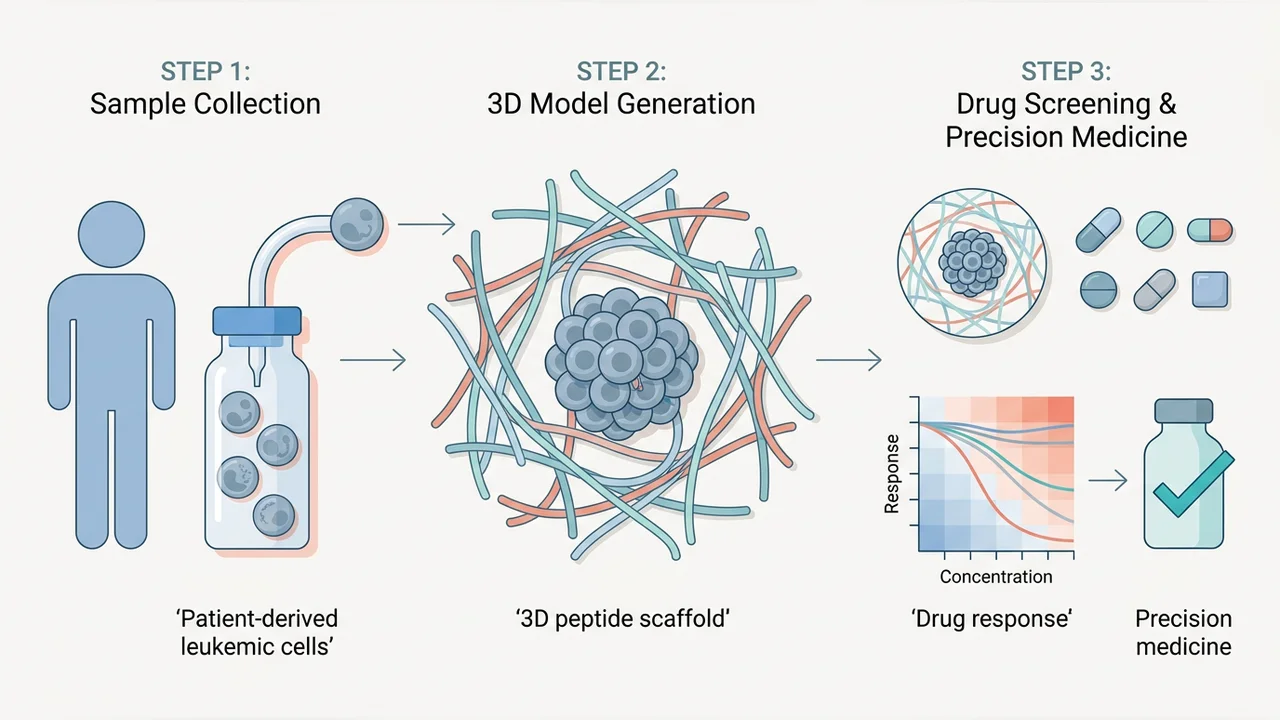
Acute myeloid leukemia (AML) has a five-year survival rate of roughly 24% in Saudi Arabia and is the second most common adult leukemia subtype in the Kingdom. Treatment selection still rests on cytogenetic risk stratification — a coarse instrument that misses much of the molecular heterogeneity now known to drive drug response. Compounding the problem, almost every published AML drug-response prediction model has been trained on Western cohorts, and existing 3D culture systems for leukemia rely on animal-derived matrices that resist standardization. This project (2023–2026, KAUST Smart-Health Initiative; joint with Charlotte Hauser, BESE) builds the missing pieces simultaneously: a biomimetic peptide-scaffold platform for patient-derived AML organoids, integrated long-read multi-omics characterization of those organoids, and population-aware machine-learning models that connect the molecular profiles to drug response.
The cellular side rests on Hauser's ultrashort self-assembling peptides (IIFK, IIZK), which form synthetic nanofibrous scaffolds with defined composition and tunable mechanics — a controlled alternative to Matrigel or collagen. Patient-derived mononuclear cells from newly diagnosed AML patients at KFSH Madinah are co-cultured with bone-marrow mesenchymal stem cells and endothelial cells in these scaffolds to reconstitute the protective bone-marrow microenvironment that mediates cell-adhesion-driven drug resistance. Each 3D-BMM is then profiled with Oxford Nanopore long-read sequencing for whole-genome variants, structural variants (including FLT3 internal tandem duplications), and direct 5mC/5hmC methylation in a single library, plus matched RNA-seq — a pipeline chosen specifically because short-read approaches lose the phased epigenetic information that AML pathogenesis depends on.
Knowledge-graph-driven drug response prediction
On the computational side, the project is benchmarking published drug-response models (DeepDR, MOLI, PaccMann, NetAML, the AML knowledge-graph approach of Qin et al.) against the screening results from the Saudi 3D-BMM cohort, and developing a new graph-neural-network prediction framework that incorporates the Saudi Pangenome Graph our group constructed. The pangenome integration matters because pharmacogenes such as CYP2D6, CYP2C19, CYP3A4, and ABCB1 carry distinct variant distributions in Saudi populations — variants that are invisible to models trained on European reference data but materially affect anthracycline and azacitidine pharmacokinetics.
Foundational outputs already in place include PAVS: a database of phenotype-associated variants in Saudi Arabia, which catalogs clinically relevant variants observed in Saudi cohorts and provides the variant-level resource the prediction models consume, and Causal Knowledge Graphs: leveraging background knowledge for causal inference at scale, which gives the project its methodological core — how to embed mechanistic biological knowledge into predictions so that recommendations remain interpretable and clinically defensible rather than opaque correlations. These connect to the broader Saudi Pangenome Graph effort the group has driven, providing the population-specific reference that the AML organoid platform exploits.
The eventual deliverable is a living biobank of Saudi AML organoids with linked multi-omics and drug-response profiles, head-to-head benchmarks of prediction models on a non-Western cohort, and a knowledge-graph-based prediction pipeline that turns the pangenome from a structural map into a tool for functional drug-response inference. Yang Liu (PhD), Sawsan Al Boeisa (MSc), and visiting student Aleksei Matveev contribute the machine-learning and pangenome-integration components; the wet-lab platform is run from the Hauser group.
Period: 2023–2026
Funding
- KAUST Smart Health Initiative
— Grant ID:
REI/1/4938-01-01(PI (co-PI)) — USD 200,000
Team
- Robert Hoehndorf — PI (KAUST (Professor of Computer Science))
- Charlotte Hauser — PI (KAUST (Biological & Environmental Sciences))
- Yang Liu — PhD (alumnus)
- Sawsan Al Boeisa — MSc (alumnus)
- Aleksei Matveev — Visiting student
Software
- NanoDesigner — Iterative refinement framework for nanobody/CDR design that explicitly models the antigen–CDR interdependence; companion code to the NanoDesigner paper. https://github.com/bio-ontology-research-group/NanoDesigner
Topics: Neuro-symbolic AI, Rare disease
Related People
Related Researchers

Yang Liu
- Ph.D. Student (former), Computer Science

Sawsan Al Boeisa
- M.S. (former), Bioengineering
Aleksei Matveev
- Visiting Student, Bio-Ontology Research Group