
Evolutionary potential of corals to adapt to climate warming
Overview
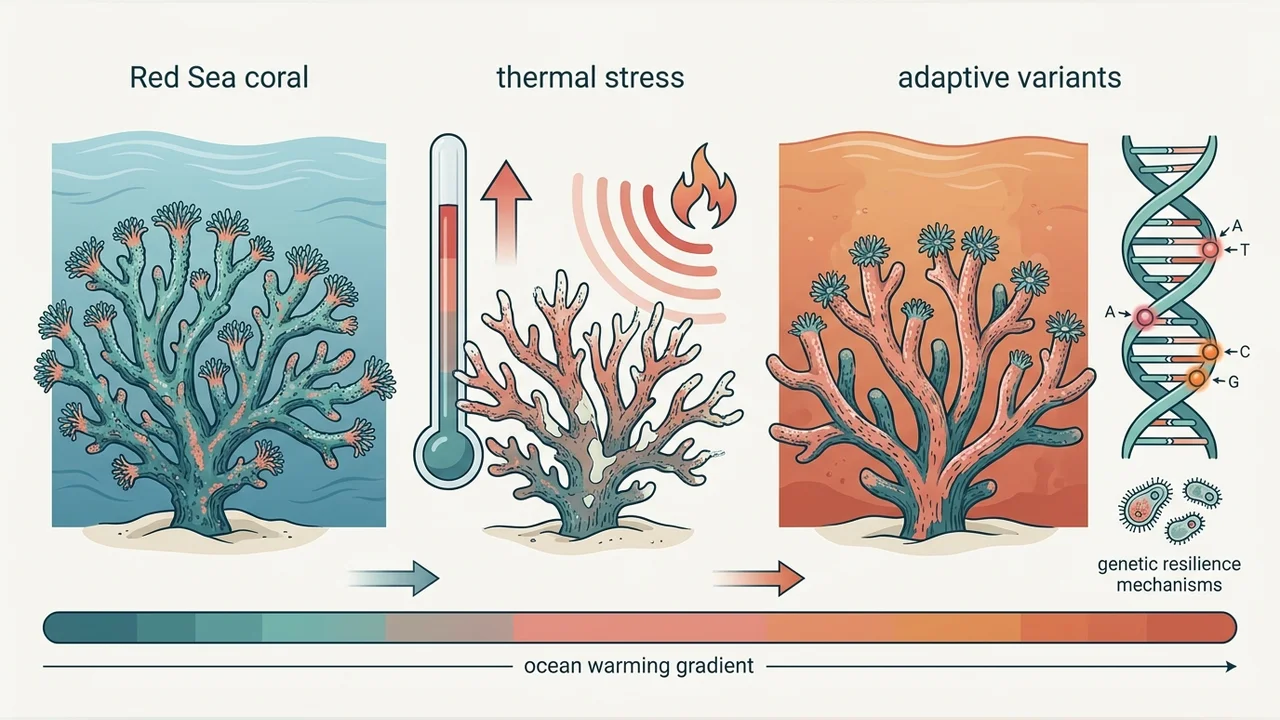
Reef-building corals in the Red Sea are exposed to among the highest sea-surface temperatures of any reef system on Earth, yet survive and reproduce at conditions that bleach corals elsewhere. Understanding the molecular basis of this resilience, and the limits of acclimatization and adaptation as the Red Sea continues to warm, is one of the central questions in marine climate biology. The project combines reciprocal transplant experiments along the north-south Red Sea thermal gradient with genome-resolved transcriptomics, epigenomics, and host-symbiont metabarcoding to dissect how the coral holobiont (animal host, Symbiodiniaceae photosymbionts, and associated bacteria) responds to acute and chronic heat stress. Hoehndorf is Co-Investigator on the project (URF/1/4697-01-01); the work is led by Manuel Aranda (BESE/Red Sea Research Center) with the BORG group contributing the bioinformatics and machine-learning components.
The bioinformatics contribution centres on extracting mechanism, not just signal, from large heterogeneous coral omics datasets. The KAUST Coral Probe Capture System and associated chromosome-scale genome assemblies for the dominant Red Sea reef builders produced by the wider consortium provide the substrate; the BORG side of the collaboration develops methods that link sequence-level observations (differentially methylated regions, allele-frequency shifts under selection, expression changes) to functional categories defined in the Gene Ontology and to pathway-level descriptions of stress response, calcification, and host-symbiont signalling. Tools developed in parallel for protein function prediction and metagenomic function (notably the DeepGO family and DeepGOMeta) are applied to non-model holobiont members for which experimental annotations are absent, allowing the bacterial component of bleaching-resistant and bleaching-susceptible communities to be characterized at the functional rather than purely taxonomic level.
The combined approach is producing several lines of evidence. Reciprocal transplants between the cooler northern Red Sea and the warmer central Red Sea reveal that thermal performance is heritable and that long-term transplantation alters DNA methylation patterns in a way consistent with epigenetic acclimatization. Symbiont community composition shifts predictably along the latitudinal gradient and tracks bleaching susceptibility, and microbiome signatures stratify by thermal regime even within a single host species. Taken together these results frame coral resilience as a holobiont-level property in which host genotype, symbiont identity, and microbial community jointly determine fate under warming, and provide candidate molecular markers for selective restoration of degraded reefs in the region.
The work directly informs the Saudi Green Initiative and KAUST's coral restoration programs by identifying genotypes, symbiont strains, and microbial associations that confer heat tolerance, and by establishing protocols (probe-capture sequencing, reproducible CWL-based analysis pipelines, and shared annotation infrastructure) that can be deployed across the Red Sea Coral Conservation effort. It also serves as a working test case for the broader BORG agenda of applying ontology-grounded machine learning to environmental microbiomes.
Period: 2022–2025
Funding
- KAUST Competitive Research Grant
— Grant ID:
URF/1/4697-01-01(CoI) — USD 150,000
Team
- Manuel Aranda — PI (KAUST (Marine Science))
- Robert Hoehndorf — CoI (KAUST (Professor of Computer Science))
Publications acknowledging this project (6)
- (2025) The application of Large Language Models to the phenotype-based prioritization of causative genes in rare disease patients [live]
- (2025) Neuro-Symbolic AI in Life Sciences [live]
- (2025) Ontology Embedding: A Survey of Methods, Applications and Resources [live]
- (2024) Large-Scale Knowledge Integration for Enhanced Molecular Property Prediction [live]
- (2023) Exploring the Use of Ontology Components for Distantly-Supervised Disease and Phenotype Named Entity Recognition
- (2023) Improving the classification of cardinality phenotypes using collections [live]
Topics: Genomics, Protein function