Improving health of Saudi population
Overview
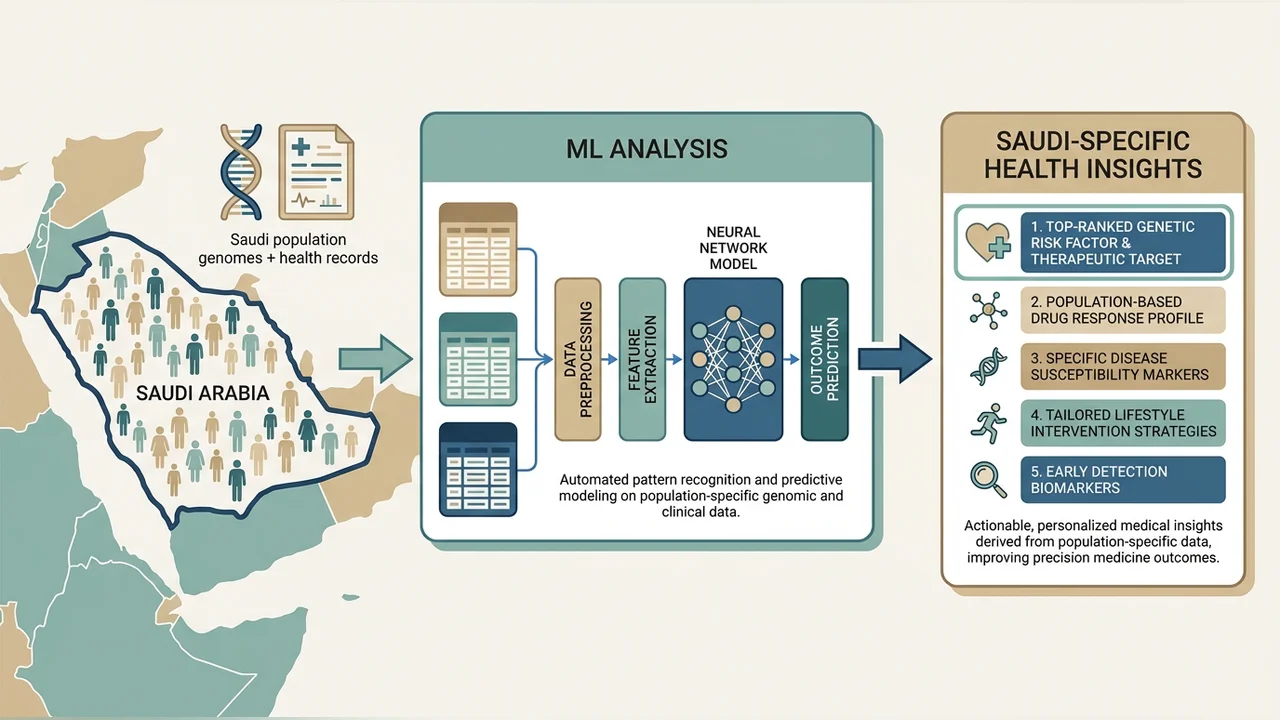
Translating modern biomedical knowledge into healthcare for Saudi Arabia requires methods that work on local data: a population with high consanguinity, a distinctive spectrum of inborn errors of metabolism, and clinical phenotypes that are not always well represented in international reference resources. The project, led by Hoehndorf at KAUST's Computational Bioscience Research Center (CBRC, now dissolved), developed health-informatics methods and resources oriented towards Saudi-population data, with a focus on rare disease, drug treatment, and the formal representation of phenotype information.
The publications produced during the project share a common methodological commitment: clinical and phenotypic information should be encoded in ontologies whose semantics can be reasoned about, not in flat lists of terms. Linking common human diseases to their phenotypes: development of a resource for human phenomics assembled large-scale disease-phenotype associations underpinning the PhenomeNET cross-species disease model; Formal axioms in biomedical ontologies improve analysis and interpretation of associated data and Semantic similarity and machine learning with biomedical ontologies showed that the additional structure paid for itself in downstream similarity and machine learning analyses. DDIEM: Drug Database for Inborn Errors of Metabolism is the resource most directly tied to the Saudi population: it curates treatments for inborn errors of metabolism — a class of disease enriched in consanguineous populations — using a structured vocabulary that links each disorder to its molecular defect and to the therapeutic intervention used clinically.
Together, these contributions defined a working pipeline from individual-patient phenotype data, through ontology-grounded representation, to phenotype-based variant prioritization and treatment lookup. The work trained two MSc students (Sakhaa Alsaedi and Yang Liu) who carried the methods forward into subsequent BORG projects on variant prioritization, polygenic risk scoring, and pangenome analysis for the Saudi population. The infrastructure produced — DDIEM, PhenomeNET, and the associated phenotype ontology tooling — remains in active use and serves as a building block for the Center of Excellence for Smart Health's downstream clinical work.
Period: 2019–2021
Funding
- KAUST Center Competitive Fund
— Grant ID:
URF/1/1976-31-01(PI) — USD 324,000
Team
- Robert Hoehndorf — PI (KAUST (Professor of Computer Science))
- Sakhaa Alsaedi — MSc (alumnus)
- Yang Liu — MSc (alumnus)
Publications acknowledging this project (2)
- (2020) DDIEM: drug database for inborn errors of metabolism [live]
- (2020) Formal axioms in biomedical ontologies improve analysis and interpretation of associated data
Topics: Neuro-symbolic AI, Rare disease