About Safana Bakheet Safana Bakheet M.S. (former), Bioengineering Rare disease Ontology engineering Neuro-Symbolic AI Biomedical Informatics Safana Bakheet completed her MSc in Bioengineering at KAUST in 2025 under the supervision of Robert Hoehndorf. Her work was carried out in collaboration with Fernando Zhapa-Camacho and developed methods for prioritising disease-causing genes by combining ontology-based phenotype representations with supervised knowledge graph embeddings. Her thesis, An Inductive, Supervised Gene-Disease Associations Method, introduces a ranking model that scores candidate disease-causing genes based on the similarity of their associated phenotypes, represented in the Mammalian Phenotype Ontology (MP) and the Projects Related Projects 2019 CompleX: Variant Prioritization in Complex Disease Tue, Jan 1 2019 - Fri, Dec 31 2021 Applied Ontology Neuro-Symbolic AI Rare disease Semantic similarity The hardest cases in clinical genome sequencing are the ones where no single variant explains the disease. As Mendelian gene discovery slows and the diagnostic rate for whole-exome sequencing stalls below 50%, growing evidence points to oligogenic and polygenic origins: combinations of medium-rare or common alleles that, individually, look unremarkable. Population-level approaches lack the power to find them, and traditional single-gene Mendelian reasoning ignores them. The CompleX project (2019–2021, with the Universities of Cambridge and Birmingham) set out to break this impasse by extending
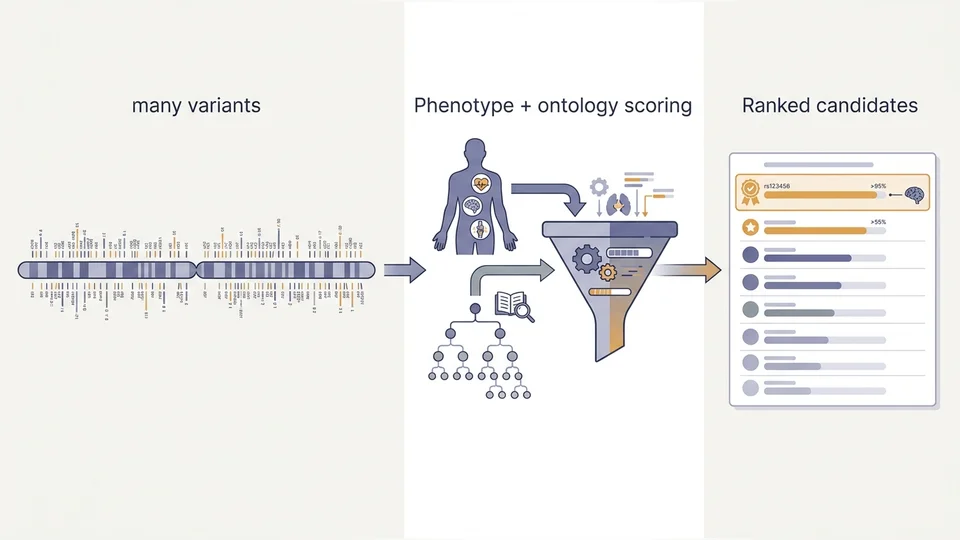
CompleX: Variant Prioritization in Complex Disease Tue, Jan 1 2019 - Fri, Dec 31 2021 Applied Ontology Neuro-Symbolic AI Rare disease Semantic similarity The hardest cases in clinical genome sequencing are the ones where no single variant explains the disease. As Mendelian gene discovery slows and the diagnostic rate for whole-exome sequencing stalls below 50%, growing evidence points to oligogenic and polygenic origins: combinations of medium-rare or common alleles that, individually, look unremarkable. Population-level approaches lack the power to find them, and traditional single-gene Mendelian reasoning ignores them. The CompleX project (2019–2021, with the Universities of Cambridge and Birmingham) set out to break this impasse by extending